Executive Summary
State Poll Results
Residents of Ohio and Arkansas are more likely than Americans nationwide to report being in fair or poor shape economically and to have a negative view of the contributions of immigrants. Ohio and Arkansas residents are also more likely than the general public to believe illegal immigrants take jobs that American workers want – a view held by 58% of Arkansas residents and 56% of Ohioans, but only 48% of Americans generally.
In spite of these more negative attitudes, residents of Ohio and Arkansas, like Americans generally, agree on the importance of a set of values—including protecting human dignity and keeping families together—that should guide reform, and residents of both states overwhelmingly support an earned path to citizenship for illegal immigrants:
- Overwhelming majorities of Ohio and Arkansas residents say enforcing the rule of law and protecting national security (87% and 88% respectively), ensuring fairness to taxpayers (80% and 89%), keeping families together (79% and 80%), and protecting the dignity of every person (78% and 81%) are very or extremely important values that should guide immigration reform.
- Nearly 9-in-10 Arkansas and Ohio residents, like Americans overall, support an earned path to citizenship for illegal immigrants (85% Ohio, 87% Arkansas, and 86% America), which is one of the key provisions of comprehensive immigration reform.
- Like Americans generally, Ohio residents favor comprehensive immigration reform over more limited enforcement-oriented alternatives by approximately 2-to-1, and Arkansas residents favor comprehensive reform by nearly the same margin. When asked to choose between a description of comprehensive reform and an argument that illegal immigrants should not be rewarded with amnesty or taxpayer-funded social services, 66% of Ohioans choose comprehensive reform with an earned path to citizenship, compared to 25% who embrace the opposing position. Fifty-seven percent of Arkansans choose comprehensive reform with an earned path to citizenship, compared to 30% who embrace the opposing position.
The Ohio and Arkansas survey reports also examine differences in attitudes toward immigration and approaches to immigration reform across lines of religion, gender, income, and educational attainment.
Catholic-Protestant Focus Groups: Ellis Island vs. Home Depot
The Ohio focus groups among white moderate voters demonstrated significant differences in attitudes toward immigration between Catholics, whose initial impressions were mostly positive and grounded in their own families’ immigration stories, and Protestants, whose initial impressions of immigrants were more likely to be negative and associated with images like day laborers looking for work at a Home Depot parking lot. Other findings from the focus group report:
- Lack of knowledge and the power of stories. Participants across all groups were quick to say that they believed the current immigration system was broken, but they had little concrete knowledge of how it was broken. When participants heard stories about hardships of becoming a citizen, ideas shifted in a more supportive direction.
- Openness to clergy leadership in the appropriate setting. Nearly all participants were wary of hearing about a political issue such as immigration reform from the pulpit, but they were open to clergy leadership in discussion or informational settings. Very few had heard anything about immigration reform at church, and nearly all were unaware of any official position of their denomination on the issue.
- Concerns about commitment of contemporary immigrants to the U.S. Moderate religious voters are not convinced that, given the opportunity, illegal immigrants would fully invest in a path to citizenship and “put out their whole being” into being here. These participants see the willingness to learn English both as an important policy point and as a proxy of immigrants’ commitment to investing in the U.S.
About the Survey and Focus Groups
PRRI’s nationwide telephone survey of 1,201 Americans, along with two state surveys of Ohio (n=402) and Arkansas (n=402) residents, was conducted March 5–11, 2010. The focus group report analyzes four focus groups held in the greater Columbus, Ohio, area on January 28, 2010, among politically moderate white Christian voters who attend religious services at least once or twice per month. Two groups were comprised of self-identified Protestants, and two groups were comprised of self-identified Catholics. The study was sponsored by the Ford Foundation.
I. Attitudes of Ohio Residents in the National Context
The Ohio Context
A plurality (48%) of Ohioans approve of the way Barack Obama is handling his job as president, an approval rating similar to all Americans (46%). However, an overwhelming majority of Ohio residents, like Americans overall, are strongly dissatisfied with the way things are going in the country today (77% and 75% respectively).
Ohioans generally resemble Americans overall in terms of political affiliation and ideology. Roughly one-quarter (26%) identify as Republican, one-third identify as Democrat, and close to 4-in-10 (37%) identify as independent. Forty-three percent of identify politically as conservative, 34% identify as moderate, and 19% identify as liberal.
Ohio residents also report slightly higher levels of economic hardship than the general public. Half of all Ohioans report that they are in only fair shape or poor shape financially, compared to 46% of Americans nationwide.
Views of the Immigration System and Immigrants
Ohioans generally agree with all Americans that the immigration system is broken or completely broken (56% each); only 5% say the system is generally working.
Ohioans report similar salience levels and degrees of knowledge about the immigration system as Americans generally. Forty-two percent of Ohio residents say the issue of immigration is very or extremely important to them personally, compared to 47% of Americans nationwide. Like Americans overall, approximately 7-in-10 (69%) of Ohio residents say they know a lot or some about the immigration process. Ohioans, however, are somewhat less likely than all Americans to report that they know a lot (15% vs. 25% respectively).
A majority (54%) of Ohio residents say it is difficult for immigrants to come to the U.S. legally today, compared to 6-in-10 Americans overall. Like the American public, Ohio residents are also much more likely to say the immigration process is more difficult today than in previous generations (35%) than to say it has become easier (21%).
Ohio residents, like Americans nationwide, are generally split about their views of the contributions of immigrants, although Ohio residents are slightly more likely to say immigrants are a burden on the country. A plurality (47%) say immigrants constitute a burden on the country by taking jobs and health care, compared to 41% who say immigrants strengthen the country because of their hard work and talents. Among all Americans, a plurality (45%) say that immigrants today strengthen the country, and 43% say immigrants are a burden to the country.
Ohio residents are more likely than Americans overall to believe that illegal immigrants take jobs American workers want. A majority (56%) agree that illegal immigrants take jobs American workers want, compared to less than half (48%) of all Americans.
Values and Support for Immigration Reform
Like their fellow Americans, Ohioans agree on the importance of a set of values to guide immigration reform and strongly support comprehensive immigration reform.
Ohioans agree with Americans nationwide about the most important values that should guide immigration reform. Like Americans overall, overwhelming majorities of Ohio residents say enforcing the rule of law and protecting national security (87%), ensuring fairness to taxpayers (80%), keeping families together (79%), and protecting the dignity of every person (78%) are very or extremely important values that should guide immigration reform.
Nearly 9-in-10 Ohio residents, like Americans overall, support an earned path to citizenship for illegal immigrants (85% and 86% respectively), one of the key provisions of comprehensive immigration reform.
Like all Americans, Ohio residents favor comprehensive immigration reform over more limited enforcement-oriented alternatives by approximately 2-to-1. When asked to choose between a description of comprehensive reform and an argument that illegal immigrants should not be rewarded with amnesty or taxpayer-funded social services, 66% of Ohioans choose comprehensive reform with an earned path to citizenship, compared to 25% who embrace the opposing position—a 41-point margin. This margin of support is slightly larger than support among Americans nationwide, where 63% choose comprehensive reform, vs. 32% who embrace the opposing position—a 31-point margin.
Ohio residents are more likely than Americans overall to say that Congress should not tackle immigration reform this year (54% vs. 48% respectively), but they are more likely to respond to the problem of family separation than the general public. A majority (54%) of Ohio residents agree that Congress should stay focused on jobs and health care this year and not attempt to pass immigration reform. On the other hand, 42% agree that Congress can handle multiple issues simultaneously and that tackling immigration reform this year will help avoid more serious problems in the future—a margin of 12 points. When the description of tackling immigration reform this year includes language describing the problem of families being separated, this margin is reduced to 4 points, with 51% of Ohioans saying Congress should not tackle it this year and 47% disagreeing.
Gender Differences in Values and Support
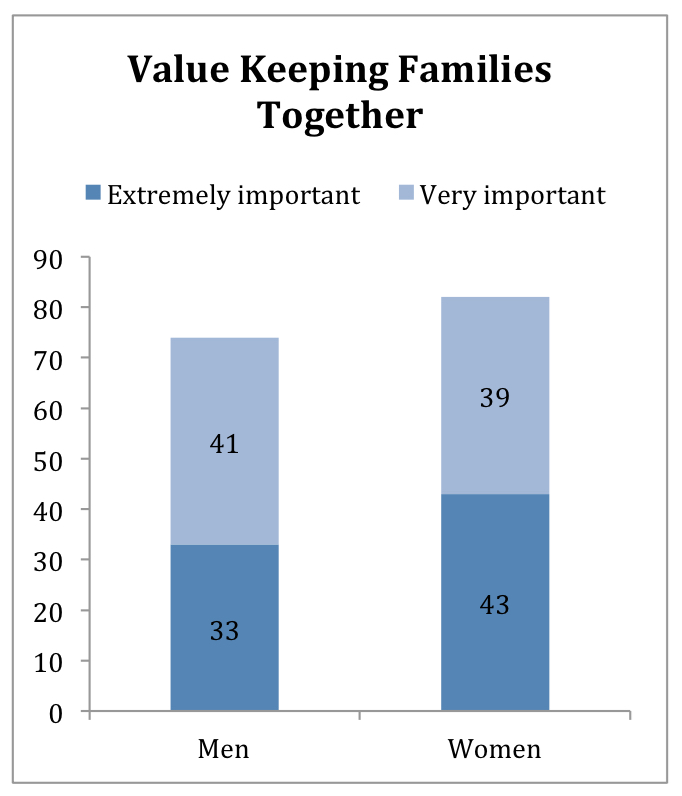 Among all Americans, there are no significant gender differences in support for values that should guide immigration reform. Among Ohio residents, men and women also largely agree on the pragmatic-legal values that should guide immigration reform. Overwhelming majorities (87%) of both men and women in Ohio say that enforcing the rule of law and protecting national security is very or extremely important values for immigration reform.
However, there are some significant gender differences among Ohioans in support for cultural-religious values that should guide immigration reform. Women place a higher premium than men on the values of keeping families together and welcoming the stranger. More than 8-in-10 (82%) women say keeping families together is very or extremely important, compared to 74% of men. Likewise, nearly six-in-ten (57%) Ohio women say that welcoming the stranger is very or extremely important compared to just 50% of Ohio men.
Differences in Views by Economic Well-being and Educational Attainment
Ohio residents who report their economic condition is fair or poor are more likely than those who report their condition is good or excellent to have unfavorable views of immigrants. Among Ohio residents who report being in good or excellent economic condition, a majority (52%) say immigrants today strengthen the country due to their hard work and talents. Among those who are doing less well, only 31% agree, and a majority (52%) say immigrants are a burden because they take jobs, housing and health care from other Americans. Nationally, these economic well-being effects are present but not as pronounced; among Americans reporting being in fair or poor economic condition, 40% say immigrants strengthen the country, and 50% say immigrants are a burden on the country.
However, more than 8-in-10 of Ohioans in both economic groups believe that the American economy would benefit if illegal immigrants became taxpaying citizens (83% fair/poor and 85% good/excellent).
The survey also found significant differences by educational attainment. Ohio residents with a college degree are much more likely to believe that immigrants benefit the country than those with a high school education or less. A majority (54%) of college- educated Ohio residents say immigrants today benefit the country because of their hard work and talents, compared to less than one-third (31%) of those with a high school education or less. A majority (51%) of Ohioans with a high school education or less support the deportation of illegal immigrants, a policy supported by only about 4-in-10 (43%) of college graduates. However, overwhelming majorities of both groups say making illegal immigrants tax-paying citizens would benefit the U.S. economy (82% and 79% respectively).
Ohio residents, like Americans nationwide, oppose a policy of deporting all illegal immigrants (55% and 56% respectively). Younger Ohio residents (age 18 to 45) are more likely to oppose deportation than older residents (63% to 49% respectively). Even among Ohioans who report being in fair or poor economic condition, less than half (46%) say they favor making a serious effort to deport all illegal immigrants.
What Ohio Residents are Hearing in Church, Expect from Clergy
Like Americans overall, few Ohio residents report hearing about immigration at their place of worship. Twenty-one percent of Ohioans, compared to 24% of Americans overall, report hearing their clergy talk about the issue of immigration sometimes or often. Majorities of Ohio residents who attend religious services regularly report being comfortable with their clergy leader speaking about immigration from the pulpit (57%), in an adult education session (79%), in a congregational newsletter or website (68%), at a local community meeting (83%), or in the local media (81%). Nationally, religious Americans report similar levels of comfort with their clergy speaking about immigration in these settings.
Re-Contact Survey Results
PRRI conducted a short re-contact survey March 31-April 5, 2010, with participants of the original survey that was fielded March 5-11, 2010. The purpose of the re-contact survey was to assess whether the passage of comprehensive health care reform on March 21, 2010, which occurred after the original survey field dates, had influenced public attitudes about the direction of the country or specifically about support for Congress tackling immigration reform this year.
In the re-contact survey, we found no significant shift in support for Congress tackling immigration reform this year either among Ohioans or Americans nationwide. Like the general public, Ohioans remain divided. The re-contact survey found that 48% percent of Ohio residents agree that Congress can handle multiple issues simultaneously and that tackling immigration reform this year will help avoid more serious problems in the future, and 50% say that Congress should stay focused on jobs this year and not attempt to pass immigration reform.
However, the re-contact survey did identify a significant increase in satisfaction with the direction of the country, compared to attitudes prior to the passage of health care reform. While 67% of Ohioans remain dissatisfied with the direction of the country, this represents a 10-point drop from dissatisfaction levels in the original survey (77%); the re-contact survey also found a significant 10-point increase (from 17% to 27%) in the number of Ohioans who said they are satisfied with the direction of the country. These shifts were consistent with increases in satisfaction among Americans overall as measured in the original and re-contact surveys.
II. Attitudes of Arkansas Residents in the National Context
The Arkansas Context
Arkansans are somewhat more likely than the general public to express disapproval of the way Barack Obama is handling his job as president (51% vs. 44% respectively). The vast majority of Arkansas residents, like Americans nationwide, are strongly dissatisfied with the way things are going in the country (79% and 75% respectively).
Compared to all Americans, Arkansans are somewhat less likely to be Republican. Only 1-in-5 identify as Republican, compared to 28% of Americans nationally. However, Arkansans have a similar ideological profile as the general public. A plurality (44%) identify politically as conservative, 28% identify as moderate, and 17% identify as liberal.
Arkansas residents also report higher levels of economic hardship than the general public. A majority (51%) of Arkansas residents report that they are in only fair shape or poor shape financially, compared to 46% of Americans nationwide.
Views of the Immigration System and Immigrants
Arkansans agree with Americans nationwide that the immigration system is broken or completely broken (56% each); only 7% say the system is generally working.
About half of Arkansas residents, like Americans overall, say the issue of immigration is very or extremely important to them personally (51% and 47% respectively). But Arkansans are significantly less likely to be informed about the immigration system than Americans overall; 59% say they know a lot or some about the immigration process, compared to 73% of the general public.
Arkansans are also less likely than Americans overall to say it is difficult for immigrants to come to the U.S. legally. Half of Arkansans, compared to 6-in-10 of all Americans, say it is somewhat or very difficult for immigrants to come to the U.S. legally today. Arkansans are also less likely than Americans overall to believe immigrants today face a more difficult time coming to the U.S. than previous generations.
Arkansas residents are more likely than the general American public to have negative views of the contributions of immigrants. Just 36% of Arkansas residents, compared to a plurality (45%) of the general public, say immigrants strengthen the country because of their hard work and talents. Arkansas residents are also more likely than the general public to believe illegal immigrants take jobs that American workers want (58% and 48% respectively).
Values and Support for Immigration Reform
Despite holding somewhat negative views of the contributions of immigrants, like their fellow Americans, Arkansans agree on the importance of a set of values to guide immigration reform and strongly support comprehensive immigration reform.
Arkansans agree with Americans nationwide about the most important values that should guide immigration reform. Overwhelming majorities of Arkansans say ensuring fairness to taxpayers (89%), enforcing the rule of law and protecting national security (88%), protecting the dignity of every person (81%), and keeping families together (80%) are very or extremely important values for immigration reform.
Nearly 9-in-10 Arkansans, like Americans overall, support an earned path to citizenship for illegal immigrants (87% and 86% respectively), one of the key provisions of comprehensive immigration reform.
Like Americans nationwide, Arkansas residents favor comprehensive immigration reform over alternatives emphasizing enforcement only by nearly 2-to-1. When asked to choose between a description of comprehensive reform and an argument that illegal immigrants should not be rewarded with amnesty or taxpayer-funded social services, 57% of Arkansans choose comprehensive reform with an earned path to citizenship, compared to 30% who embrace the opposing position—a 27-point margin. This support is only slightly lower than support among Americans nationwide, where 63% choose comprehensive reform, compared to 32% who embrace the opposing position.
Arkansans are also significantly more likely than Americans overall to believe immigration reform is an urgent problem for families. When provided with an argument about the importance of dealing with immigration reform because it separates families, 56% say Congress should fix the system this year, compared to less than half (46%) of all Americans.
Gender Differences in Support for Values
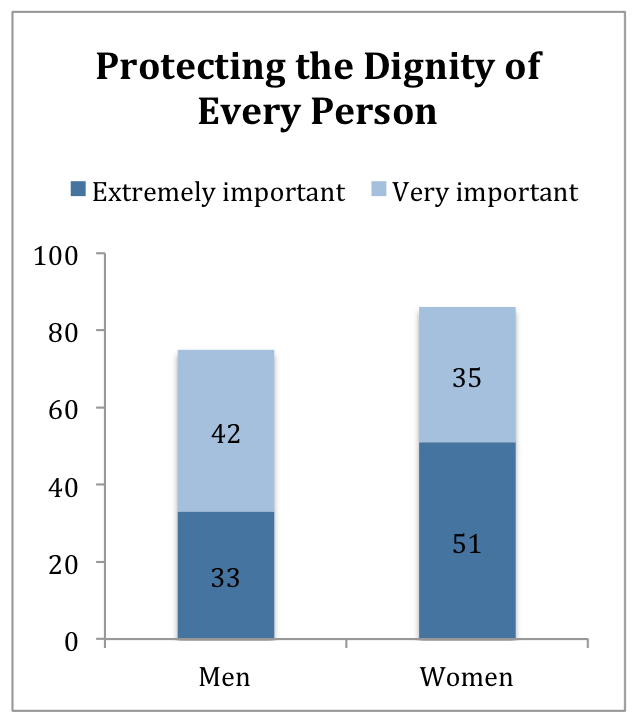 While there are no significant gender differences among all Americans, Arkansas women hold stronger views than Arkansas men on some key values that should guide immigration reform. Eighty-six percent of women say protecting the dignity of every person is extremely or very important. Seventy- five percent of men agree, but significantly fewer men than women say it is an extremely important value (33% vs. 51%). More than 8-in-10 women also say keeping families together is an extremely (49%) or very (35%) important value. Three quarters of men also agree, but again significantly fewer men than women (35% vs. 49%) say that it is extremely important.
Differences in Views by Economic Well-being
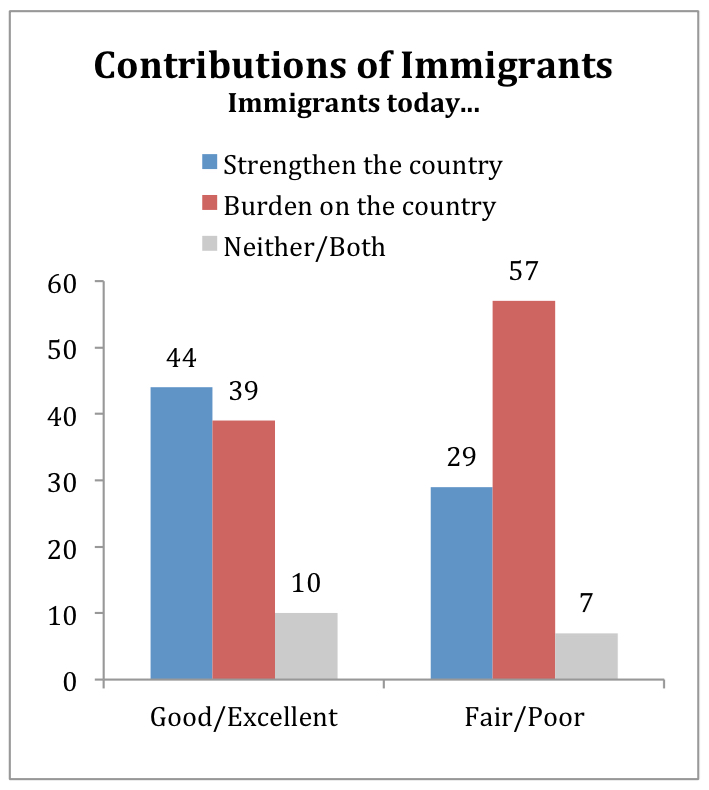 Arkansas residents who report their economic condition is fair or poor are more likely than those who report their condition is good or excellent to have unfavorable views of immigrants. Among Arkansas residents who report being in good or excellent economic condition, a slight plurality (44%) say immigrants today strengthen the country due to their hard work and talents. Among those who are doing less well, only 29% agree, and a majority (57%) say immigrants are a burden because they take jobs, housing and health care from other Americans. Nationally, these economic well-being effects are present but not as pronounced; among Americans reporting being in fair or poor economic condition, 40% say immigrants strengthen the country, and 50% say immigrants are a burden on the country.
Views of illegal immigrants also differ significantly between Arkansas residents who are well off financially and those who are struggling. Two-thirds of Arkansans who report being in fair or poor economic condition say that illegal immigrants take jobs Americans want, compared to only 49% of those who report being in good or excellent condition.
However, approximately 8-in-10 Arkansans in both economic groups believe that the American economy would benefit if illegal immigrants became taxpaying citizens (79% fair/poor and 81% good/excellent condition).
Half of Arkansas residents disagree that we should make a serious effort to deport all illegal immigrants, compared to 56% of Americans overall. Younger Arkansans (age 18 to 45) are significantly more likely than older Arkansans to oppose deportation (59% to 46%). Even among Arkansans who report being in fair or poor economic condition, less than half (49%) say they favor making a serious effort to deport all illegal immigrants.
What Arkansans are Hearing in Church, Expect from Clergy
Like Americans overall, few Arkansans report hearing about the issue of immigration at their place of worship. Twenty-two percent, compared to 24% of all Americans, report hearing their clergy talk about the issue of immigration sometimes or often. Majorities of people in Arkansas who attend religious services regularly report being comfortable with their clergy leader speaking about immigration in a variety of settings: from the pulpit (53%), in their congregation’s newsletter or website (63%), in an adult education session (74%), at a local community meeting (76%), or in the local media (77%). Nationally, religious Americans report similar levels of comfort with their clergy speaking about immigration in these settings.
Re-Contact Survey Results
PRRI conducted a short re-contact survey March 31-April 5, 2010, with participants of the original survey that was fielded March 5-11, 2010. The purpose of the re-contact survey was to assess whether the passage of comprehensive health care reform on March 21, 2010, which occurred after the original survey field dates, had influenced public attitudes about the direction of the country or specifically about support for Congress tackling immigration reform this year.
In the re-contact survey, we found no significant shift in support for Congress tackling immigration reform this year either among Arkansans or Americans nationwide. The re-contact survey found that 48% of Arkansas residents agree that Congress can handle multiple issues simultaneously and that tackling immigration reform this year will help avoid more serious problems in the future, and 45% say that Congress should stay focused on jobs this year and not attempt to pass immigration reform.
However, the re-contact survey did identify a significant increase in satisfaction with the direction of the country, compared to attitudes prior to the passage of health care reform. While 69% of Arkansans remain dissatisfied with the direction of the country, this represents a 10-point drop from dissatisfaction levels in the original survey (79%); the re-contact survey also found a significant 7-point increase (from 16% to 23%) in the number of Arkansans who said they are satisfied with the direction of the country. These shifts were consistent with increases in satisfaction among Americans overall as measured in the original and re-contact surveys.
Click here for a PDF of the Ohio survey report, the Ohio focus group report, and the Arkansas survey report.
Recommended citation:
Jones, Robert P., and Daniel Cox. “Religion, Values, and Immigration Reform: A Look at the States.” PRRI. 2010. http://www.prri.org/research/religion-values-and-immigration-reform-a-look-at-the-states/.